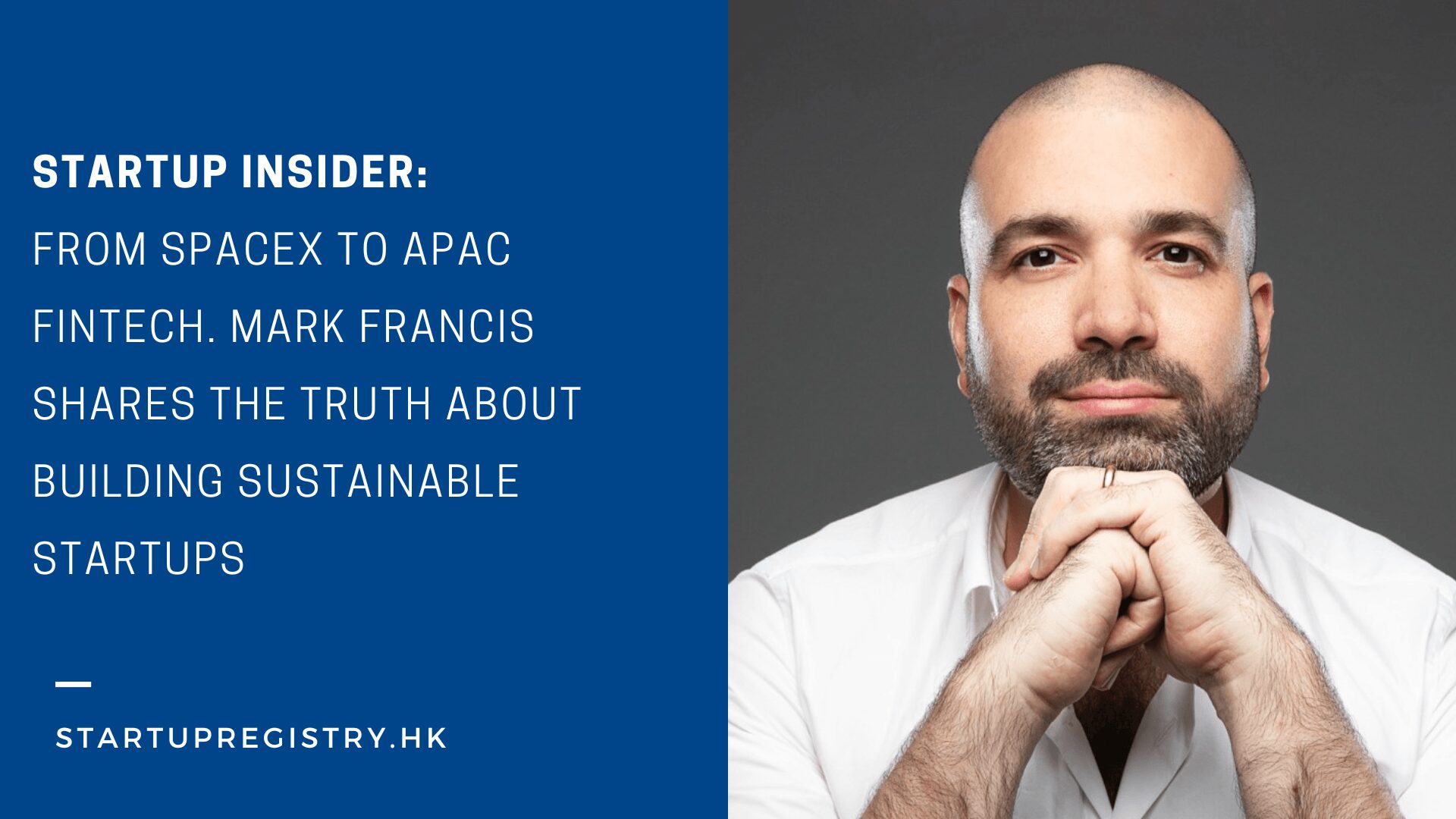
Today, we are thrilled to introduce Mark Francis, a prominent serial entrepreneur, ecosystem builder, and angel investor who has been a driving force in the Asia-Pacific startup landscape since 2007. Based in Hong Kong, Mark has an extensive track record spanning the HRTech, FinTech, and executive search industries.
Mark is currently the CEO of Preferrd, an innovative HRTech startup leveraging cutting-edge AI and gamified referrals to revolutionize talent acquisition for a multi-generational workforce. He is also the Co-Founder and Non-Executive Director of Zetl, a pioneering embedded financing FinTech platform that has disbursed over $1B USD in non-dilutive loans to asset-light SMEs across APAC. Through his private investment and consulting firm, Tyros, Mark actively backs early-stage startups in FinTech, HRTech, and Web3, and notably holds a position as an investor in global giants such as SpaceX. Beyond the boardroom, Mark dedicates his time to the Hong Kong community as a Board Member of the Eurasian Society, supporting education and opportunities for local ethnic minorities.
Today, Mark shares his unvarnished insights on the evolution of Hong Kong’s business ecosystem, the power of alternative financing, and what it truly takes to scale a sustainable business in Asia.
You have been an active part of the Hong Kong ecosystem since 2007. Looking back, what are the most significant shifts you’ve observed in the city’s support for early-stage startups? What makes Hong Kong still the ultimate hub for international founders today?
When I first started working in Hong Kong back in 2007, the startup ecosystem barely existed in any formal sense. The infrastructure we take for granted now, such as HKSTP, Cyberport, InvestHK’s StartmeupHK, and a functioning angel network, was either nascent or absent. Capital was almost exclusively institutional, and the idea of a founder raising a pre-seed round from local angels was pretty unusual.
What’s changed most is the legitimacy of the founder path. Hong Kong now has a few operators who’ve built, exited, and reinvested. The government has leaned in with real programmes (although more support is still needed). And the city’s position as a gateway between mainland China, Southeast Asia, and global capital markets is, if anything, more strategically valuable than it was 20 years ago.
What makes Hong Kong still compelling for international founders is the combination of factors you can’t easily replicate elsewhere: common-law jurisdiction, free flow of capital, proximity to the world’s largest manufacturing and consumer base, and a talent pool that genuinely spans East and West. For anyone building a business with an APAC dimension, there’s no better base.
Through your firm Tyros, you invest in early-stage APAC startups, but your portfolio also includes global giants like SpaceX. What do you look for in a startup team before you decide to invest in them, whether they are based in Hong Kong or scaling globally?
The honest answer is that I look for the same things at every stage: a founder who understands the problem at a level that’s hard to fake, a market that’s large enough to matter, and some early signal that the team can execute under pressure.
The SpaceX position is a reminder that the best opportunities don’t always have a neat early-stage narrative. What I look for in a team is intellectual honesty, founders who know what they don’t know, and then build around it. I’ve seen too many well-funded companies fail because the founding team couldn’t update their beliefs when the market provided new information or couldn’t find a compromise during founder disputes.
For APAC-based startups specifically, I also look for founders who understand the structural differences between markets in the region. Southeast and East Asia are not a monolith. A business that works in Singapore doesn’t automatically work in Vietnam or Indonesia. The founders who get that early tend to build more durable companies.
In your recent appearance on the Life of a Founder podcast, you spoke about founder resilience and how to navigate setbacks. What advice do you have for a foreign entrepreneur moving to Hong Kong to launch their first business?
The most important thing I’d tell a foreign entrepreneur coming to Hong Kong is: don’t underestimate how much of early success here is relationship-driven. The city rewards people who show up consistently, build genuine trust, and play a long game. Transactional networking gets you nowhere.
On the resilience side: the setbacks that matter most aren’t the dramatic ones. They’re the slow grind of a partnership that takes six months longer than expected, a hire that doesn’t work out, a product that needs to be rebuilt. The founders who survive are the ones who’ve built a support system made up of advisors, peers, a co-founder, and people who can tell them the truth when they need to hear it.
Practically: get your legal and banking infrastructure right from day one. It sounds boring, but a messy corporate structure or a delayed bank account has killed more early-stage companies in Hong Kong than bad products have.
Hong Kong is a city of incredible opportunity, but also high operating costs (rents, talent, infrastructure). From your experience, how should early-stage companies structure their initial capital to survive and thrive here?
The mistake I see most often is founders treating Hong Kong’s cost base as a fixed constraint rather than a variable they can manage. The city is expensive, but it’s also highly efficient if you structure it correctly.
My advice: keep your headcount lean for longer than feels comfortable. Use the city’s professional services ecosystem — lawyers, accountants, HR platforms — rather than building those functions in-house too early. And be honest about what you actually need to be physically present for versus what can be run remotely or from a lower-cost base in the region.
At Preferrd, we’ve been deliberate about where we put people. The product team is hybrid, the commercial relationships are managed from Hong Kong, and we’re running pilots in India and Vietnam through a partner, where the cost-to-traction ratio is significantly better than it would be if we’d tried to prove the model in a more expensive market first.
At Zetl, your team reviewed thousands of SME financials and noted that messy books can quickly kill funding options. Since we at Startupr frequently provide accounting advisory services to help founders avoid these traps, what financial “red flags” do you see entrepreneurs consistently overlook that delay their growth?
The red flags I see most consistently are founders who can’t tell you their gross margin off the top of their heads, companies that have never separated personal and business expenses, and cap tables that have been papered over rather than properly structured.
While building Zetl, we reviewed hundreds, then eventually thousands, of SME financials, aiming for deep granularity. The single biggest killer of funding options is not bad performance — it’s opacity. Investors and lenders can work with a struggling business if they can clearly see what’s happening. What they can’t work with is a business where the numbers don’t tell a coherent story.
The practical fix is simple: get a proper accounting system in place from day one, even if it’s just Xero with a part-time bookkeeper. The cost is trivial compared to the optionality it preserves.
Why is non-dilutive financing (like what you provide at Zetl) becoming so critical for modern B2B tech and asset-light companies in APAC, compared to traditional VC equity fundraising?
The core insight at Zetl is that equity is the most expensive form of capital for a business that has predictable revenue. If you’re an asset-light B2B tech company with recurring contracts, you’re giving away ownership to solve a cash-flow problem that debt could address more cheaply.
Non-dilutive financing has become more critical in APAC because the region’s SME base has matured. There are now thousands of companies with $500K–$5M in ARR that are fundable on a revenue basis but don’t fit the VC growth profile. They’ve been underserved by both traditional banks (which typically want hard assets) and VCs (which want hypergrowth). Zetl was built for exactly that gap.
For founders: the question isn’t equity vs. debt in the abstract. It’s what you’re using the capital for. If it’s to fund growth that will generate returns faster than the cost of equity, take equity. If it’s to bridge a timing gap in receivables or fund a contract you’ve already won, debt is almost always the better answer.
Your newest venture, Preferrd, leverages AI and gamified referrals to connect companies with Gen X, Millennial, and Gen Z talent. Why is traditional recruitment failing the younger workforce, and how does your incentivized referral engine change the game?
Traditional recruitment is failing the younger workforce for a structural reason: it was built for a world where credentials were hard to fake, and referrals were informal. Both of those assumptions have collapsed.
AI has made it trivially easy to generate a polished CV that passes an ATS screen. The result is that hiring managers are drowning in applications that look qualified but aren’t, and genuinely strong candidates are getting lost in the noise. We’ve seen documented cases of the same fake identity succeeding in 45 out of 46 job applications. That’s not a fringe problem — it’s a systemic failure of the current model.
Preferrd’s answer is to flip the model. Instead of filtering out bad candidates after the fact, we verify credentials at the point of application and use a referral-based scoring engine to surface candidates with a human endorsement. The referrer has skin in the game they earn when their referral succeeds, which creates a quality signal that no AI can fake.
For Gen Z and Millennial candidates specifically, the referral model resonates because it rewards network and reputation rather than just what’s said on a CV. It’s a more honest reflection of how hiring actually works at the senior level, applied earlier in the career.
You are managing multiple ventures and investments, as well as your role at the Eurasian Society. Since Hong Kong is famous for its 24/7 hustle culture, what is your personal framework for maintaining sanity, health, and a good work-life balance while scaling businesses?
I’ll be honest: I don’t think “work-life balance” is the right frame for a founder. The more useful question is sustainability — can you keep going at this pace for five years, not just five months? I use a Work/Life Integration approach to manage both effectively.
What works for me is being deliberate about energy, not just time. I protect the things that restore me, such as exercise, time with family, and switching off from screens for defined periods. I also work on being more disciplined about not attending meetings and commitments that drain energy without producing output. For example, we try to limit internal team meetings at Preferrd to just 1 per day, to free up time for external meetings with partners, clients, or investors, plus focused project time.
Hong Kong’s hustle culture is real, but the founders I’ve seen burn out aren’t the ones who work hard — they’re the ones who work hard on the wrong things, or repeat the same patterns. Clarity about priorities is the best productivity tool I’ve found.
At Startupregistry.hk, we have spent over 20 years helping international entrepreneurs remove the heavy lifting of business setup – handling corporate bureaucracy, licensing, accounting, and banking advisory. As a seasoned founder who also ran an operational hub (Castle Peak), how critical do you think it is for incoming foreign founders to delegate these administrative and compliance burdens to local experts from day one?
For a foreign founder coming to Hong Kong, the city’s professional services ecosystem is genuinely world-class. The lawyers, accountants, and company secretaries who work with startups here understand the regulatory environment, the banking relationships, and the common pitfalls. Delegating that infrastructure from day one isn’t a cost — it’s an investment in your own focus.
The founders who try to do everything themselves in the early days almost always end up rebuilding their corporate structure later, at much greater cost and distraction. So try to get it right from the start.
Building Sustainable Success in Hong Kong
The interview with Mark Francis confirms what we at Startupregistry have been seeing for over 15 years. Hong Kong remains one of the world’s most dynamic business hubs, but success here favors the prepared. Today’s startup founder no longer needs to get lost in confusing bureaucracy or risk rejection from investors due to accounting mistakes. The key to surviving and scaling rapidly in the Asian market is to hand over the operational burden to local experts and focus entirely on what matters most—your product, your team, and your customers.
We would like to thank Mark for this inspiring interview, and, on behalf of the entire Startupregistry team, we wish him the best of luck and continued success in his businesses and future ventures.
If you enjoyed this interview and would like to be featured in our Startupr Insider, please contact us. We would love to share your story and achievements with our community.