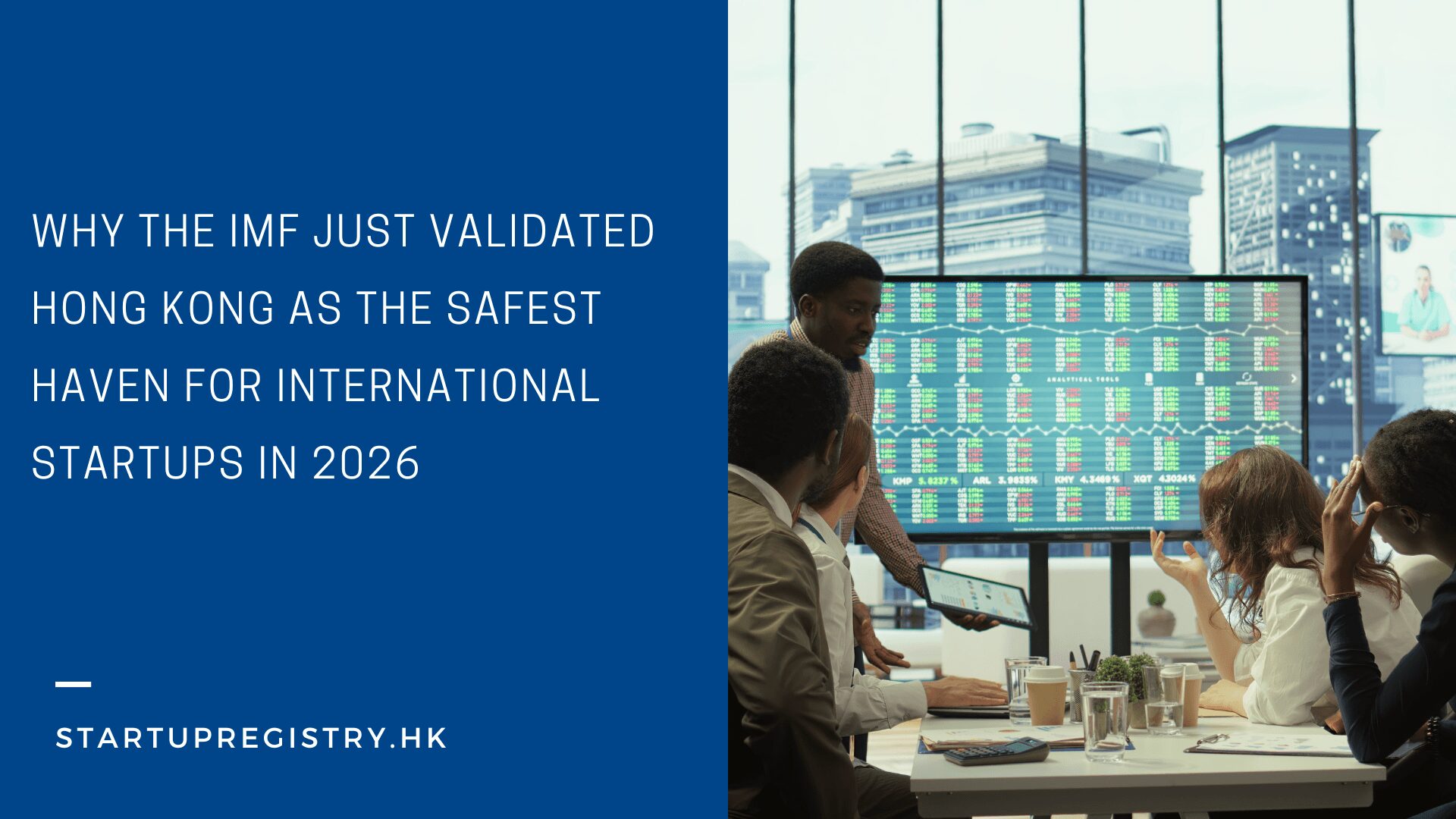
The Hong Kong IMF Article IV Consultation 2026 was a reminder of the city’s strengths. Released in May, the report showed solid economic growth and a strong banking sector.
If you’re building or expanding a business in Asia, that’s a promising sign. A stable economy and clear rules provide the predictability you need when planning for growth. The report also looks at the factors behind Hong Kong’s performance. It covers the supporting policies and initiatives, and the city’s geographical advantage.
If Hong Kong is on your shortlist for business incorporation, here’s what the IMF report says.
How Does Hong Kong Keep Its Currency Stable?
The IMF backed Hong Kong’s Linked Exchange Rate System (LERS). LERS has linked the Hong Kong dollar to the US dollar since 1983. In the report, the IMF said the arrangement continues to support monetary and financial stability.
HKMA’s Chief Executive Officer, Mr. Eddie Yue, said, “I welcome the Mission’s continued support for the LERS, a key anchor of Hong Kong’s financial system and economy. I am pleased to note the Mission’s recognition of our robust regulatory and supervisory frameworks, underpinned by strong buffers and prudent practices in the banking sector.”
Why is it important for your business?
- The exchange rate system helps reduce uncertainty around currency movements.
- Businesses can plan budgets, contracts, and cross-border transactions with greater confidence.
- The framework has remained in place through multiple economic cycles and periods of market stress.
The IMF mentioned Hong Kong’s foreign exchange reserves. They stood at about US$428 billion in 2025. These reserves give policymakers additional capacity to respond to periods of market volatility.
The report also found that Hong Kong’s banks remained strong and profitable in 2025. This is in addition to healthy capital and liquidity levels.
Why Does the IMF See Hong Kong as a “Super-Connector”?
The IMF described Hong Kong as the super-connector between Mainland China and the world. Through this, you can access Chinese markets while remaining connected to the global economy.
The report mentions initiatives such as Connect schemes and the Greater Bay Area (GBA). It also said that HK remains a leading offshore RMB hub. All these initiatives help you have better access to customers, investors, and business opportunities.
Then there is the digital finance support. The report notes the Fintech 2030 initiative. It focuses on data, payment structure AI, tokenization, and quantum resilience.
Besides all this, Hong Kong continues to develop rules for crypto and related assets. This helps businesses adopt new technologies without operating in a grey area. The IMF also sees AI as a potential new growth opportunity in the long run.
Startupr perspective: “From our experience with international startups, macro statistics don’t tell the whole story. Founders rarely move to Hong Kong for a single policy or isolated tax incentive. When we tested this expansion route with a logistics tech client last quarter, their main goal was optionality. They needed to pitch to international investors and sell into China simultaneously. The IMF’s latest assessment data validates that point. Hong Kong’s status as a global financial center super-connector helps businesses access more opportunities as they grow.
What Long-Term Investments Is Hong Kong Making?
Apart from the demographic-related initiatives, HK is investing in long-term projects. One example is the Northern Metropolis. It’s a large-scale development plan creating new sources of economic growth.
When you expand into a new market, long-term plans provide the base for future growth. Projects like these create new opportunities for businesses in the years ahead.
| Looking beyond the report: The IMF specifically discusses initiatives such as the Northern Metropolis and the GBA. However, our internal Hong Kong expert team continuously tracks several parallel development projects. Hong Kong-Shenzhen Innovation and Technology Park (Hetao): Supports research, innovation, and technology collaboration between Hong Kong and Shenzhen. Kai Tak Development: Expanding office, retail, housing, and community infrastructure in a major redevelopment area. Smart City Blueprint 2.0: Accelerating digital transformation across local public and private sectors. All these show the city’s focus on technology and long-term economic growth. |
What Challenges Did the IMF Identify?
The IMF’s findings were largely favorable. But it also found a few risk areas to consider:
- Commercial real estate remains under pressure: The IMF repeatedly mentions commercial real estate (CRE) as a near-term risk. Falling collateral values and refinancing pressures continue to affect parts of the sector.
- Global uncertainty could affect growth: The report warns about geopolitical tensions and financial market volatility as risks for HK.
- Population aging and labor challenges: It also notes that reduced labor force participation and an aging population are long-term challenges.
- Weak private investment: The IMF notes that private investment remains below pre-pandemic levels. This makes some businesses cautious about expansion.
Wrapping Up: The Ultimate Place for Your Startup to Grow
Choosing where to expand is rarely a simple decision. Economic conditions, financial systems, long-term growth plans, and market access all play a role.
The IMF’s latest report gives a better picture of where Hong Kong stands in 2026. Growth continued in 2025, and banks remain well capitalized. Also, major projects aimed at future growth are already underway.
While near-term risks exist, Hong Kong provides the base international startups need to scale. Ready to incorporate in Hong Kong? Contact Startupregistry today to effortlessly manage your company formation.